
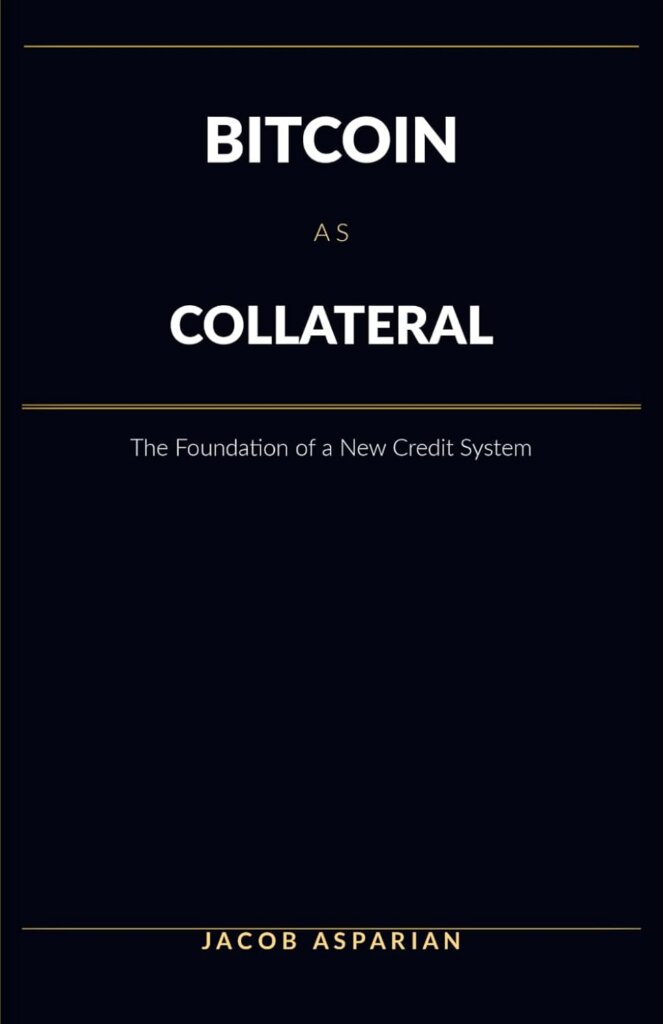
Bitcoin as Collateral
The Foundation of a New Credit System
By Jacob Asparian
#1 Amazon Best Seller Financial Risk Management
Amazon Top 10 Corporate Finance
Amazon Top 10 Corporate Finance
Subscribre
Get the first chapter free
About the Author
Jacob Asparian is the founder of Allodial Capital, a Canadian capital markets firm specializing in Bitcoin as institutional collateral.
Read more →Why
The Argument
Most discussions of Bitcoin focus on price. This book focuses on its structural properties as collateral — and the financial architecture that follows.
Major transitions in reserve and collateral standards have produced new generations of financial institutions. Bitcoin represents the next such transition. Bitcoin as Collateral makes the first-principles case for why Bitcoin's properties — bearer integrity, verifiability, continuous liquidity, mathematical scarcity — make it uniquely suited to support a new generation of institutional credit markets.
The book is intended for capital allocators, treasurers, lawyers, accountants, and policy makers who want to understand the institutional implications of Bitcoin as collateral, not as currency.
Contents
What's Inside
Sections on the historical pattern of collateral transitions, the mechanism by which Bitcoin enables structurally improved credit markets, the failure modes of the first generation of crypto-native firms, the institutional architecture required to operate on a Bitcoin standard, and the regulatory and capital markets implications for Canada specifically.
Book Contents
A Note on This Book1
Introduction2
A Note on Bitcoin6
Act I — The Problem
Chapter 1 — The Mispricing of Risk8
Chapter 2 — How Credit Systems Fail12
Act II — A New Form of Collateral
Chapter 3 — The Collateral Frame17
Chapter 4 — Volatility and Collateral Performance20
Chapter 5 — The Properties of High-Quality Collateral24
Act III — System Design and Implementation
Chapter 6 — Where Systems Fail29
Chapter 7 — The Mechanics of Bitcoin-Backed Lending35
Chapter 8 — Parameters and Risk Control41
Chapter 9 — Structuring Yield Without Breaking the System45
Chapter 10 — The Bitcoin Credit Stack48
Chapter 11 — Energy, Mining, and the Physical Layer51
Chapter 12 — Capital Allocation and the Shift in Structure54
Chapter 13 — Legal Infrastructure and Jurisdictional Reality57
Chapter 14 — Portfolio Stress Testing: What the History Actually Shows64
Chapter 15 — Operational Infrastructure72
Chapter 16 — Objections and Failure Modes80
Conclusion87
Acknowledgments93
About the Author94